
By Johan Restrepo | Owner & Principal Designer at Cali Scaping
Living in the rolling hills of Moraga and the greater Lamorinda region offers unparalleled natural beauty. However, residing adjacent to East Bay open spaces comes with a critical responsibility: wildfire preparedness. Homeowners often ask me if creating a fire-defensible space means sacrificing trees, privacy, and curb appeal to end up with a barren, gravel yard.
My answer is always no. At Cali Scaping, we specialize in fire-defensible landscape design that meets local wildfire safety codes while elevating your outdoor living experience.
1. Understanding the Defensible Space Zones (Zone 0 to Zone 2)
Compliance with local mandates, such as the Moraga-Orinda Fire District (MOFD) guidelines, requires strategic landscaping divided into distinct defense zones around your home:
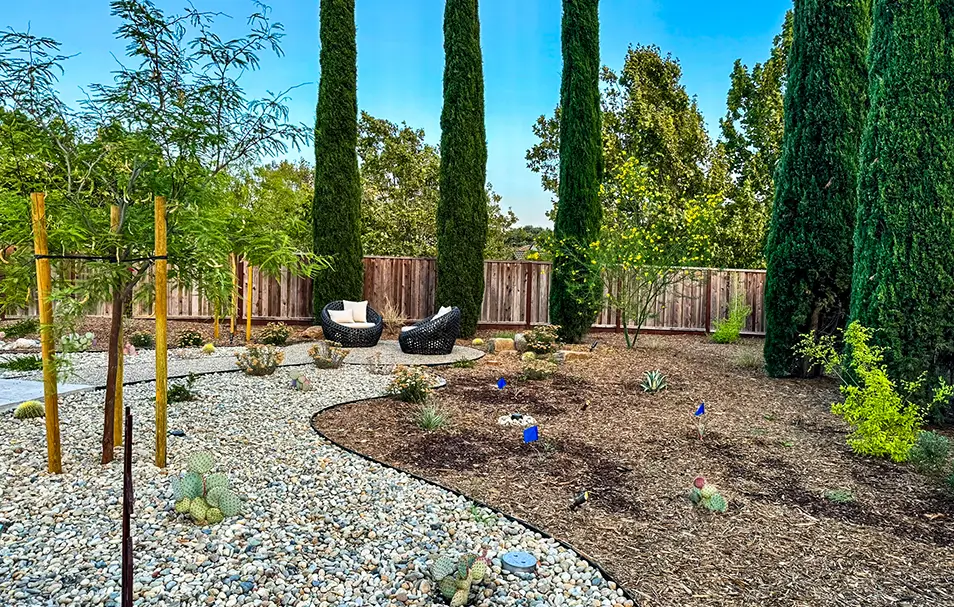
- Zone 0 (0 to 5 Feet – Ember-Resistant Zone): The most critical area directly adjacent to your home’s foundation. We utilize non-combustible hardscaping materials such as natural stone pavers, gravel, and flagstone, completely eliminating highly flammable organic mulches, dry grasses, and any other combustible materials.
- Zone 1 (5 to 30 Feet – Lean, Clean, and Green Zone): This area is designed to slow and stop advancing flames. We focus on low-growing ground covers, well-spaced drought-tolerant perennials, and hardscape features like retaining walls or gravel pathways that act as natural firebreaks.
- Zone 2 (30 to 100 Feet – Reduced Fuel Zone): In this outer perimeter, we focus on brush clearing, removing ladder fuels (plants that allow fire to climb from the ground into tree canopies), and maintaining proper spacing between mature tree crowns.
2. Plant Selection: Choosing Fire-Resistant & Drought-Tolerant Species
No plant is 100% fireproof, but certain native California and Mediterranean species store higher moisture content, produce less deadwood, and contain low amounts of flammable oils or resins:
- Recommended Native Species: Coast Live Oak (Quercus agrifolia), Manzanita cultivars (Arctostaphylos), California Fuchsia (Epilobium canum), and Yarrow (Achillea millefolium).
- Plants to Avoid Near Structures: Highly resinous or oily plants like Juniper, Cypress, Eucalyptus, and invasive grasses, which ignite easily and burn at extreme temperatures.
3. Hardscaping as Structural Firebreaks
One of the most effective ways to secure a sloped hillside property is using hardscape elements to disrupt fuel continuity. By integrating stone retaining walls, concrete patios, gravel walkways, and masonry seating walls, we create functional outdoor living spaces that double as protective fire barriers for your home.
4. The Takeaway: Safety and Elegance Can Coexist
Protecting your property against wildfire hazards doesn’t mean compromising on design. Through thoughtful plant selection, non-combustible hardscaping, and proper zone management, we build landscapes that are both resilient and visually captivating.
If you need a professional site assessment to make your Moraga, Orinda, or Lafayette property fire-defensible, contact us directly at Cali Scaping to schedule an on-site consultation.