
By Johan Restrepo | Owner & Principal Designer at Cali Scaping
One of the most frequent questions homeowners in Moraga, Lafayette, Orinda, and across Contra Costa County ask during initial patio consultations is: «Should I install interlocking concrete pavers or a traditional poured concrete patio?»
In the East Bay, this decision comes down to how each material responds to ground movement caused by our expansive local clay soil. Here is a technical breakdown of how pavers and poured concrete compare in terms of durability, maintenance, and long-term property value.
1. Ground Movement and Flexibility: The Clay Soil Factor
East Bay clay soil expands when saturated during winter rains and contracts during hot summer months.
- Poured Concrete Slabs: Because a poured concrete slab is a single rigid mass, ground shifting underneath creates immense internal stress. Over time, even reinforced concrete slabs frequently develop hairline cracks. However, incorporating strategically placed contraction joints helps divert structural pressure to those designated areas, which minimizes unwanted hairline cracking across the surface.
- Interlocking Concrete Pavers: Pavers are individual units set over a compacted aggregate base and joint sand bed. This flexible system allows micro-adjustments during natural soil expansion without cracking the surface. If a single paver is ever damaged, it can be individually replaced without disturbing the rest of the patio.
2. Drainage Integration and Permeability
Managing surface runoff is essential for protecting home foundations and adjacent retaining walls in East Bay properties.
- Permeable Paver Options: Interlocking paver systems can be engineered with wider aggregate joints to allow rainwater to filter directly into a subsurface gravel reservoir, significantly reducing surface runoff during winter storms.
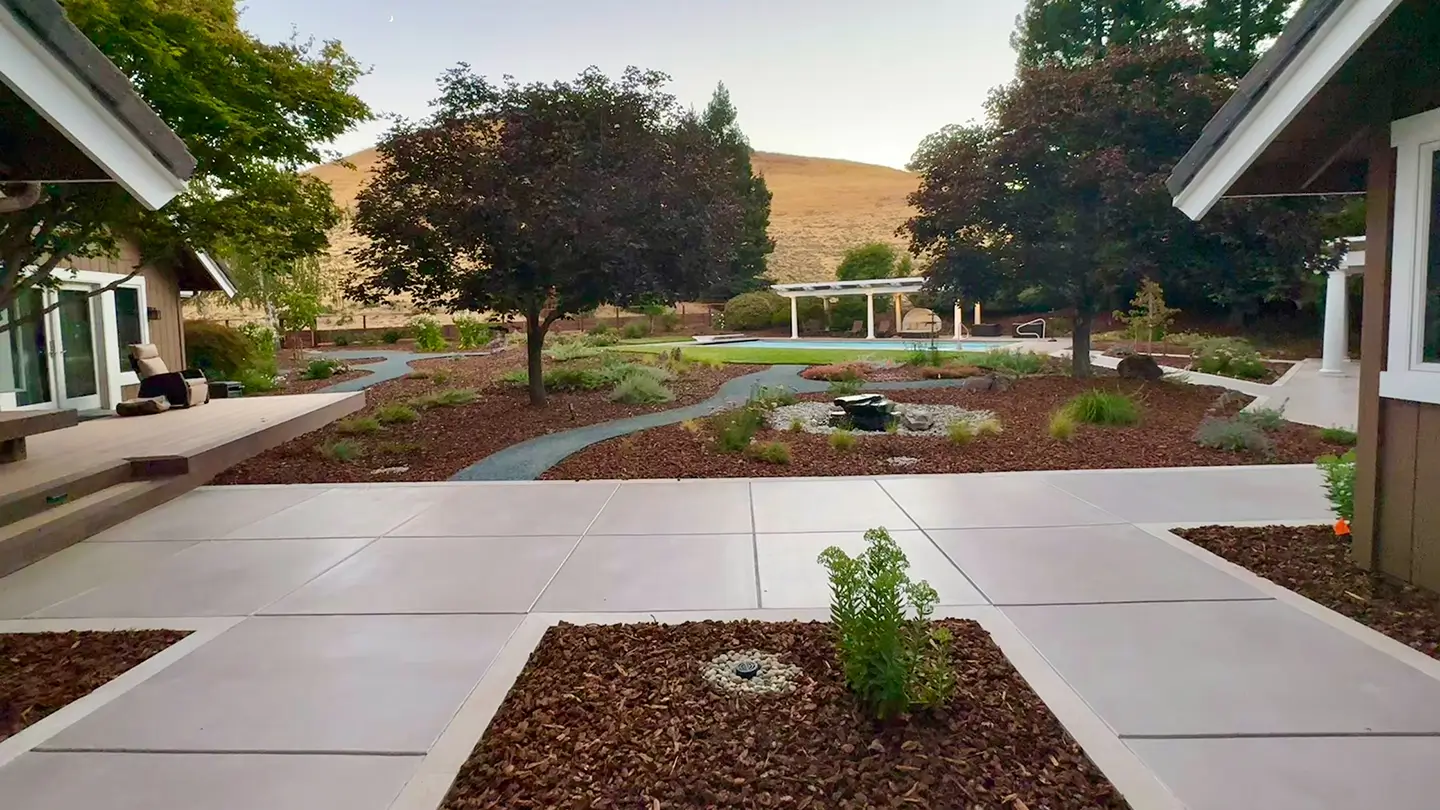
- Poured Concrete Slope Requirements: All hardscape should be properly sloped at 2%, which manages water runoff without compromising furniture stability. Most importantly, when a poured concrete slope is designed and executed properly, it eliminates the need for unsightly surface drain grates in the middle of your hardscape.
3. Longevity, Aesthetics, and Resale Value
High-end residential properties in Lamorinda benefit significantly from the architectural sophistication of interlocking pavers. Pavers offer rich textures, varied color palettes, and superior slip resistance around outdoor kitchens and pool decks compared to standard broom-finish concrete.
However, longevitywise, concrete is the king. Poured concrete maintains its original structural color and surface tone over decades, whereas pavers will naturally fade in color over time due to UV exposure and weathering.
4. The Takeaway: Base Preparation Is Key to Any Hardscape Success
While pavers offer superior performance in clay soil, their longevity depends entirely on what lies beneath. At Cali Scaping, every paver patio installation begins with deep soil excavation, geotextile fabric installation, and a densely compacted aggregate base (minimum 4 inches) to prevent dipping or settling.
If you are planning a patio upgrade in Moraga, Orinda, Lafayette, or the broader East Bay, contact us directly at Cali Scaping to schedule an on-site design assessment.